Breed guide
Appenzell Cattle Dog
A source-linked starting point for Appenzell Cattle Dog: Driving -, watch -, guard -, h ouse- and farm dog. Use this as context for the individual dog's routine, not as a prediction of behaviour or health.
About this breed
How to use this Appenzell Cattle Dog profile
For Appenzell Cattle Dog, the verified profile records Official FCI name, FCI group, Country of origin. These references explain what to observe and what to adjust in daily life; they do not establish a guaranteed behaviour rate, diagnosis, or outcome for an individual dog.
How to recognize the breed
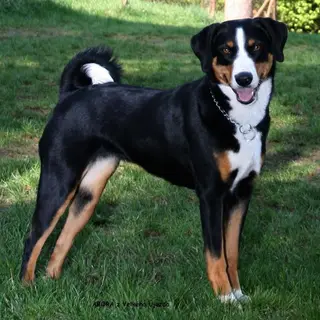
Use the whole outline, coat, proportions, and movement together. A single photo or colour is not enough to establish breed identity.
APPENZELLER SENNENHUND
FCI nomenclature page > breed namen°2 - Pinscher and Schnauzer - Molossoid and Swiss Mountain and Cattledogs
FCI nomenclature page > GroupSWITZERLAND
FCI nomenclature page > Country of origin of the breed5/5/2003
FCI nomenclature page > English standard dateBody condition and trend
Height and weight references are already shown above; they are context, not a personal target. Use the BCS tool and the individual dog's ribs, waist, abdominal tuck, age, and trend.
Daily life priorities
Adjust difficulty, duration, and handling for the individual dog. The linked long-tail pages turn these profile facts into practical routines.
Health checks and when to call the vet
If you are choosing a puppy or checking a breeding record, ask for the named test, result, date, and scheme. These checks help assess breeding risk; they are not a diagnosis of an individual dog.
Questions owners ask about Appenzell Cattle Dog
Verified facts
| Official FCI name | APPENZELLER SENNENHUND FCI nomenclature page > breed name |
|---|---|
| FCI group | n°2 - Pinscher and Schnauzer - Molossoid and Swiss Mountain and Cattledogs FCI nomenclature page > Group |
| Country of origin | SWITZERLAND FCI nomenclature page > Country of origin of the breed |
| FCI standard date | 5/5/2003 FCI nomenclature page > English standard date |
| FCI standard PDF | https://www.fci.be/Nomenclature/Standards/046g02-en.pdf FCI nomenclature page > English standard PDF link |
| Utilization | Driving -, watch -, guard -, h ouse- and farm dog. Today also a versatile working and family dog FCI standard PDF page text > utilization |
| General appearance | Well muscled; seen from front forelegs straight and parallel; standing not too close. Shoulder: Shoulder blade long and sloping. Upper arm: Same length or only slightly shorter than should er blade. Angle with shoulder blade not too blunt. Elbows: Close fitting. Forearm: Straight, lean. Pastern: Seen from front in straight continuation of the forearm. Seen… FCI standard PDF page text > general_appearance |
| Historical summary | In 1853 an Appenzell Cattle Dog was first described in the book “Tierleben der Alpenwelt” (Animal Life in the Alps) as a “high -pitch barking, short -haired, medium size, multicolour cattle dog of a quite even Spitz type, which can be found in c ertain regions and is used partly to guard the homestead, partly to herd cattl FCI-St. N° 46 / 05.05.2003 3 At… FCI standard PDF page text > historical_summary |
How to use this profile
Use the facts on this page as a starting point, then observe the individual dog. A breed label does not establish behaviour frequency, diagnosis, or a guaranteed outcome. Medical and screening claims remain subject to review.
Research status
Source register
Use the tools