Breed guide
Auvergne Pointer
A source-linked starting point for Auvergne Pointer: Pointing breed. Use this as context for the individual dog's routine, not as a prediction of behaviour or health.
About this breed
How to use this Auvergne Pointer profile
For Auvergne Pointer, the verified profile records Official FCI name, FCI group, Country of origin. These references explain what to observe and what to adjust in daily life; they do not establish a guaranteed behaviour rate, diagnosis, or outcome for an individual dog.
How to recognize the breed
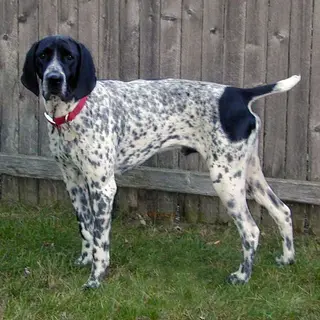
Use the whole outline, coat, proportions, and movement together. A single photo or colour is not enough to establish breed identity.
BRAQUE D'AUVERGNE
FCI nomenclature page > breed namen°7 - Chiens d'arrêt
FCI nomenclature page > GroupFRANCE
FCI nomenclature page > Country of origin of the breed02/04/2004
FCI nomenclature page > English standard dateBody condition and trend
Height and weight references are already shown above; they are context, not a personal target. Use the BCS tool and the individual dog's ribs, waist, abdominal tuck, age, and trend.
Daily life priorities
Adjust difficulty, duration, and handling for the individual dog. The linked long-tail pages turn these profile facts into practical routines.
Health checks and when to call the vet
If you are choosing a puppy or checking a breeding record, ask for the named test, result, date, and scheme. These checks help assess breeding risk; they are not a diagnosis of an individual dog.
Questions owners ask about Auvergne Pointer
Verified facts
| Official FCI name | BRAQUE D'AUVERGNE FCI nomenclature page > breed name |
|---|---|
| FCI group | n°7 - Chiens d'arrêt FCI nomenclature page > Group |
| Country of origin | FRANCE FCI nomenclature page > Country of origin of the breed |
| FCI standard date | 02/04/2004 FCI nomenclature page > English standard date |
| FCI standard PDF | https://www.fci.be/Nomenclature/Standards/180g07-en.pdf FCI nomenclature page > English standard PDF link |
| Utilization | Pointing breed FCI standard PDF page text > utilization |
| Temperament | Gentle dog, very affectionate, intelligent and obedient. Its training consists mainly of developing its natural qualities. Its sense of smell is powerful. It adapts well to family life. HEAD CRANIAL REGION: Skull and muzzle : T he lines of the skull are slightly divergent towards the front (a characterized braque). The head is long, proportional to the… FCI standard PDF page text > temperament |
| General appearance | Rectilinear, of mediu m proportions. Robust dog, strongly boned, but without heaviness, showing a c FCI-St. N° 180 / 02.04.2004 3 FCI standard PDF page text > general_appearance |
| Historical summary | The Auvergne pointer is a very ancient breed, present in the Cantal region for more than two centuries. Descen ding from a multi -pointer common source, derivation has been made by a selection to which the Knights of Malta might have participated. Created by and for hunters, it has a strong identity reinforced by its coat FCI standard PDF page text > historical_summary |
| Gait | Movement of average amplitude but with a sustained rhythm which confers its notorious endurance to t he dog. Its habitual hunting gait is an average gallop, regular and slightly rocking. SKIN: Fine enough, rather loose without exaggeration. COAT Hair: Short, not too fine, never hard, shiny FCI standard PDF page text > gait |
How to use this profile
Use the facts on this page as a starting point, then observe the individual dog. A breed label does not establish behaviour frequency, diagnosis, or a guaranteed outcome. Medical and screening claims remain subject to review.
Research status
Source register
Use the tools