Breed guide
Canarian Warren Hound
A source-linked starting point for Canarian Warren Hound: Is used for rabbit hunting , and to that end, adapts perfectly to the many irregularities of the terrain by using his prodigious nose, his sight and hearing. Use this as context for the individual dog's routine, not as a prediction of behaviour or health.
About this breed
How to use this Canarian Warren Hound profile
For Canarian Warren Hound, the verified profile records Official FCI name, FCI group, Country of origin. These references explain what to observe and what to adjust in daily life; they do not establish a guaranteed behaviour rate, diagnosis, or outcome for an individual dog.
How to recognize the breed
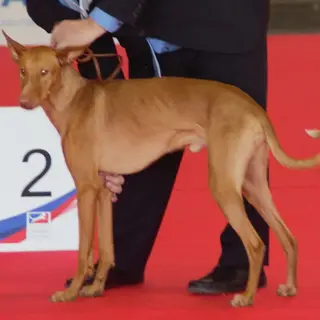
Use the whole outline, coat, proportions, and movement together. A single photo or colour is not enough to establish breed identity.
PODENCO CANARIO
FCI nomenclature page > breed namen°5 - Spitz and primitive types
FCI nomenclature page > GroupSPAIN
FCI nomenclature page > Country of origin of the breed11/3/1999
FCI nomenclature page > English standard dateBody condition and trend
Height and weight references are already shown above; they are context, not a personal target. Use the BCS tool and the individual dog's ribs, waist, abdominal tuck, age, and trend.
Daily life priorities
Adjust difficulty, duration, and handling for the individual dog. The linked long-tail pages turn these profile facts into practical routines.
Health checks and when to call the vet
If you are choosing a puppy or checking a breeding record, ask for the named test, result, date, and scheme. These checks help assess breeding risk; they are not a diagnosis of an individual dog.
Questions owners ask about Canarian Warren Hound
Verified facts
| Official FCI name | PODENCO CANARIO FCI nomenclature page > breed name |
|---|---|
| FCI group | n°5 - Spitz and primitive types FCI nomenclature page > Group |
| Country of origin | SPAIN FCI nomenclature page > Country of origin of the breed |
| FCI standard date | 11/3/1999 FCI nomenclature page > English standard date |
| FCI standard PDF | https://www.fci.be/Nomenclature/Standards/329g05-en.pdf FCI nomenclature page > English standard PDF link |
| Utilization | Is used for rabbit hunting , and to that end, adapts perfectly to the many irregularities of the terrain by using his prodigious nose, his sight and hearing. He endures easily high temperatures and is capable of hunting from dawn to nightfall. Thanks to his nose and his hearing, he can also detect the presence of rabbits at the bottom of natural crevices of… FCI standard PDF page text > utilization |
| General appearance | It is a dog of medium size, built on longish lines, slender, light and extremely resistant. The skeleton is well developed. The absence of layers of fat make it possible to see the rib cage as well as the spinal column and the hip bones. The musculature is developed to the highest degree, lean, the contractions of the muscles are visible through the skin FCI standard PDF page text > general_appearance |
| Important proportions | Slightly longer than high. Chest well developed without coming down to the elbow. Muzzle slightly longer than th FCI-St. N° 329 / 03.11.1999 4 EYES: Oblique, small, almond -shaped. More or less dark amber in colour; the intensity depends on the colour of the coat. The expression is intelligent and full of nobleness. EARS: Quite big, they rise up when the… FCI standard PDF page text > important_proportions |
| Gait | The trot must be agile, extended and very light. SKIN: Firm, adheres without folds to the body. COAT Hair: Smooth, short and dense FCI standard PDF page text > gait |
How to use this profile
Use the facts on this page as a starting point, then observe the individual dog. A breed label does not establish behaviour frequency, diagnosis, or a guaranteed outcome. Medical and screening claims remain subject to review.
Research status
Source register
Use the tools