Breed guide
East Siberian Laika
A source-linked starting point for East Siberian Laika: Hunting dog for all-round purposes. Use this as context for the individual dog's routine, not as a prediction of behaviour or health.
About this breed
How to use this East Siberian Laika profile
For East Siberian Laika, the verified profile records Official FCI name, FCI group, Country of origin. These references explain what to observe and what to adjust in daily life; they do not establish a guaranteed behaviour rate, diagnosis, or outcome for an individual dog.
How to recognize the breed
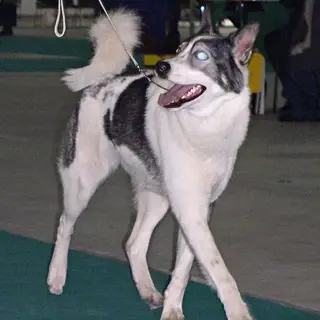
Use the whole outline, coat, proportions, and movement together. A single photo or colour is not enough to establish breed identity.
VOSTOTCHNO-SIBIRSKAÏA LAÏKA
FCI nomenclature page > breed namen°5 - Spitz and primitive types
FCI nomenclature page > GroupRUSSIAN FEDERATION
FCI nomenclature page > Country of origin of the breed3/2/2011
FCI nomenclature page > English standard dateBody condition and trend
Height and weight references are already shown above; they are context, not a personal target. Use the BCS tool and the individual dog's ribs, waist, abdominal tuck, age, and trend.
Daily life priorities
Adjust difficulty, duration, and handling for the individual dog. The linked long-tail pages turn these profile facts into practical routines.
Health checks and when to call the vet
If you are choosing a puppy or checking a breeding record, ask for the named test, result, date, and scheme. These checks help assess breeding risk; they are not a diagnosis of an individual dog.
Questions owners ask about East Siberian Laika
Verified facts
| Official FCI name | VOSTOTCHNO-SIBIRSKAÏA LAÏKA FCI nomenclature page > breed name |
|---|---|
| FCI group | n°5 - Spitz and primitive types FCI nomenclature page > Group |
| Country of origin | RUSSIAN FEDERATION FCI nomenclature page > Country of origin of the breed |
| FCI standard date | 3/2/2011 FCI nomenclature page > English standard date |
| FCI standard PDF | https://www.fci.be/Nomenclature/Standards/305g05-en.pdf FCI nomenclature page > English standard PDF link |
| Utilization | Hunting dog for all-round purposes FCI standard PDF page text > utilization |
| General appearance | Dog of medium size with strong and compact built. The length of the body, from the forechest to the buttocks, is slightly superior to the height at the withers. The head is rather big and very strong. The muscles are well developed. Strong bone structure; more powerfu l in males than in females. Sexual dimorphism is clearly pronounced FCI standard PDF page text > general_appearance |
| Important proportions | Males almost rectangular to rectangular and female slightly longer. Index of format (height/length): Males: 100/104-109. Females: 100/106-111. The height at the withers exceeds the height at the croup by 1 -2 cm (males) and is equal to or exceeds the height at the croup by 1 cm (females). The length of the muzzle is slightly less than half the length of the… FCI standard PDF page text > important_proportions |
How to use this profile
Use the facts on this page as a starting point, then observe the individual dog. A breed label does not establish behaviour frequency, diagnosis, or a guaranteed outcome. Medical and screening claims remain subject to review.
Research status
Source register
Use the tools