Breed guide
Finnish Lapponian Dog
A source-linked starting point for Finnish Lapponian Dog: Originally a herder and watch dog used in work of keeping reindeer. Use this as context for the individual dog's routine, not as a prediction of behaviour or health.
About this breed
How to use this Finnish Lapponian Dog profile
For Finnish Lapponian Dog, the verified profile records Official FCI name, FCI group, Country of origin. These references explain what to observe and what to adjust in daily life; they do not establish a guaranteed behaviour rate, diagnosis, or outcome for an individual dog.
How to recognize the breed
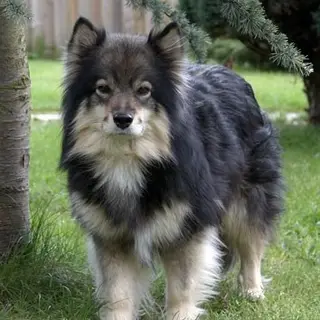
Use the whole outline, coat, proportions, and movement together. A single photo or colour is not enough to establish breed identity.
SUOMENLAPINKOIRA
FCI nomenclature page > breed namen°5 - Spitz and primitive types
FCI nomenclature page > GroupFINLAND
FCI nomenclature page > Country of origin of the breed10/12/2016
FCI nomenclature page > English standard dateBody condition and trend
Height and weight references are already shown above; they are context, not a personal target. Use the BCS tool and the individual dog's ribs, waist, abdominal tuck, age, and trend.
Daily life priorities
Adjust difficulty, duration, and handling for the individual dog. The linked long-tail pages turn these profile facts into practical routines.
Health checks and when to call the vet
If you are choosing a puppy or checking a breeding record, ask for the named test, result, date, and scheme. These checks help assess breeding risk; they are not a diagnosis of an individual dog.
Questions owners ask about Finnish Lapponian Dog
Verified facts
| Official FCI name | SUOMENLAPINKOIRA FCI nomenclature page > breed name |
|---|---|
| FCI group | n°5 - Spitz and primitive types FCI nomenclature page > Group |
| Country of origin | FINLAND FCI nomenclature page > Country of origin of the breed |
| FCI standard date | 10/12/2016 FCI nomenclature page > English standard date |
| FCI standard PDF | https://www.fci.be/Nomenclature/Standards/189g05-en.pdf FCI nomenclature page > English standard PDF link |
| Utilization | Originally a herder and watch dog used in work of keeping reindeer. Today also popular as a companion dog. FCI CLASSIFICATION: Group 5 Spitz and Primitive types. Section 3.4 Nordic Watchdogs and Herders. Without working trial FCI standard PDF page text > utilization |
| General appearance | Powerful with strong bones. Viewed from the front straight and parallel. Shoulders: Slightly oblique. Upper arms : As long as the shoulder blades. The angle between shoulder and upper arm is rather open. Elbows: Approximately at the level of the lower edge of the ribcage, pointing straight backwards. Forearms: Rather strong, vertical. Carpus: Flexible.… FCI standard PDF page text > general_appearance |
| Height | males 49 cm and females 44 cm with a tolerance of 3 cm. The type is more important than the size FCI standard PDF page text > height |
| Historical summary | For hundreds of years the Sami people have used dogs of the same type as Finnish Lapponian Dog as reindeer herders and watchdogs in the northern parts of Fennoscandia and Russia. The first standard of the Lapponian Herder was establishe d by the Finnish Kennel Club in 1945. The breed´s name was changed into Lapponian Dog in 1967. In the 1970:s the type and… FCI standard PDF page text > historical_summary |
How to use this profile
Use the facts on this page as a starting point, then observe the individual dog. A breed label does not establish behaviour frequency, diagnosis, or a guaranteed outcome. Medical and screening claims remain subject to review.
Research status
Source register
Use the tools