Breed guide
Griffon Nivernais
A source-linked starting point for Griffon Nivernais: Scent hound used mainly for shooting of wild boar, generally in a pack but also individually. Use this as context for the individual dog's routine, not as a prediction of behaviour or health.
About this breed
How to use this Griffon Nivernais profile
For Griffon Nivernais, the verified profile records Official FCI name, FCI group, Country of origin. These references explain what to observe and what to adjust in daily life; they do not establish a guaranteed behaviour rate, diagnosis, or outcome for an individual dog.
How to recognize the breed
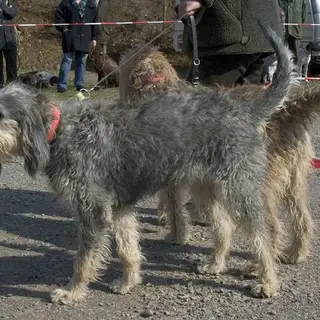
Use the whole outline, coat, proportions, and movement together. A single photo or colour is not enough to establish breed identity.
GRIFFON NIVERNAIS
FCI nomenclature page > breed namen°6 - Scent hounds and related breeds
FCI nomenclature page > GroupFRANCE
FCI nomenclature page > Country of origin of the breed4/2/2004
FCI nomenclature page > English standard dateBody condition and trend
Height and weight references are already shown above; they are context, not a personal target. Use the BCS tool and the individual dog's ribs, waist, abdominal tuck, age, and trend.
Daily life priorities
Adjust difficulty, duration, and handling for the individual dog. The linked long-tail pages turn these profile facts into practical routines.
Health checks and when to call the vet
If you are choosing a puppy or checking a breeding record, ask for the named test, result, date, and scheme. These checks help assess breeding risk; they are not a diagnosis of an individual dog.
Questions owners ask about Griffon Nivernais
Verified facts
| Official FCI name | GRIFFON NIVERNAIS FCI nomenclature page > breed name |
|---|---|
| FCI group | n°6 - Scent hounds and related breeds FCI nomenclature page > Group |
| Country of origin | FRANCE FCI nomenclature page > Country of origin of the breed |
| FCI standard date | 4/2/2004 FCI nomenclature page > English standard date |
| FCI standard PDF | https://www.fci.be/Nomenclature/Standards/017g06-en.pdf FCI nomenclature page > English standard PDF link |
| Utilization | Scent hound used mainly for shooting of wild boar, generally in a pack but also individually FCI standard PDF page text > utilization |
| Temperament | Behaviour: Very good nose, piercing, and par ticularly enjoying difficult terrains and thickets. Temperament: Excellent at approaching and very good hunter, it’s courageous when holding firm without being reckless. Its courage and initiative allow it to be used successfully in small packs for hunting wild boar. Although it can easily be taught hunting that… FCI standard PDF page text > temperament |
| General appearance | Good poise. Generally, and at rest, the forelegs seen in profile appear a little to the rear of the vertical (under him in front). Shoulder: Slightly inclined, dry, well set on the chest. Elbow: Set well to the body. Forearm: Appears rather plentiful because of the coat but in reality, it is drier than thick and quite straight. Metacarpus (Pastern):… FCI standard PDF page text > general_appearance |
| Height | Outside the limits defined by the standard. • Defects: Noticeable invali dating d efect. Anatomical malformation. N.B.: • Male animals should have two apparently normal testicles fully descended into the scrotum. • Onl FCI standard PDF page text > height |
| Historical summary | The Griffon Nivernais may have descended from Gallic ho unds (Canis Segusius) used by the Gauls, and from the grey Saint Louis dogs. This breed was much appreciated for 200 years, up to Louis XI’s reign, then was abandoned in the royal packs by Francis I who preferred white hounds. Nevertheless, certain Niver nais region noblemen conserved it up to the time… FCI standard PDF page text > historical_summary |
| Important proportions | Body length (point of shoulder to point of buttocks) is slightly greater than height at shoulder. Skull and muzzle are of the same length FCI standard PDF page text > important_proportions |
How to use this profile
Use the facts on this page as a starting point, then observe the individual dog. A breed label does not establish behaviour frequency, diagnosis, or a guaranteed outcome. Medical and screening claims remain subject to review.
Research status
Source register
Use the tools