Breed guide
Italian Short Haired Segugio
A source-linked starting point for Italian Short Haired Segugio: Dog for hunting especially the hare and the wild boar. Use this as context for the individual dog's routine, not as a prediction of behaviour or health.
About this breed
How to use this Italian Short Haired Segugio profile
For Italian Short Haired Segugio, the verified profile records Official FCI name, FCI group, Country of origin. These references explain what to observe and what to adjust in daily life; they do not establish a guaranteed behaviour rate, diagnosis, or outcome for an individual dog.
How to recognize the breed
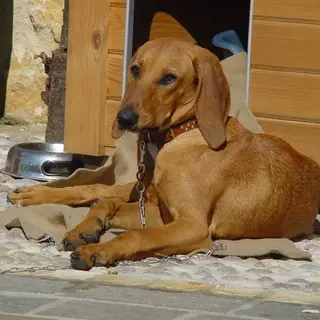
Use the whole outline, coat, proportions, and movement together. A single photo or colour is not enough to establish breed identity.
SEGUGIO ITALIANO A PELO FORTE
FCI nomenclature page > breed namen°6 - Scent hounds and related breeds
FCI nomenclature page > GroupITALY
FCI nomenclature page > Country of origin of the breed12/17/2015
FCI nomenclature page > English standard dateBody condition and trend
Height and weight references are already shown above; they are context, not a personal target. Use the BCS tool and the individual dog's ribs, waist, abdominal tuck, age, and trend.
Daily life priorities
Adjust difficulty, duration, and handling for the individual dog. The linked long-tail pages turn these profile facts into practical routines.
Health checks and when to call the vet
If you are choosing a puppy or checking a breeding record, ask for the named test, result, date, and scheme. These checks help assess breeding risk; they are not a diagnosis of an individual dog.
Questions owners ask about Italian Short Haired Segugio
Verified facts
| Official FCI name | SEGUGIO ITALIANO A PELO FORTE FCI nomenclature page > breed name |
|---|---|
| FCI group | n°6 - Scent hounds and related breeds FCI nomenclature page > Group |
| Country of origin | ITALY FCI nomenclature page > Country of origin of the breed |
| FCI standard date | 12/17/2015 FCI nomenclature page > English standard date |
| FCI standard PDF | https://www.fci.be/Nomenclature/Standards/198g06-en.pdf FCI nomenclature page > English standard PDF link |
| Utilization | Dog for hunting especially the hare and the wild boar FCI standard PDF page text > utilization |
| Temperament | The Segu gio is perfectly adapted to the most difficult terrains and can be used as well in the mountains as on level ground. Very resistant and fast, he works with ardour and passion, alone or in a pack. Compared with the shorthaired subjects, he is more reserved, less exuberant, wise, calm and FCI-St. N° 198 / 17.12.2015 4 Muzzle: The muzzle measures half… FCI standard PDF page text > temperament |
| General appearance | The forequarters, seen in profile, follow a vertical line which, from the scapulo -humeral articula tion, must reach the ground while touching the point of the toes, whereas a lowered vertical from the elbow point must divide in two almost equal parts, (the large being the front part), the forearm and the carpus, coming out at mid length on the back of t he… FCI standard PDF page text > general_appearance |
| Coat | Hair: On the body the len gth of the hair should not be more than 5 cm. The hair is definitely rough, except on the head, on the ears, the legs, the tail and the muzzle, where the hair is usually less rough than on the body and the lips; under the lips, the hair, although of moderate length, forms the so -called beard. The hair on the superciliary arches is… FCI standard PDF page text > coat |
| Important proportions | Height from ground to withers is equal to the length of the body measured from the scapulo -humeral articulation to the point of the ischium (from point of shoulder to point of buttock). The withers mus t not be too prominent, but they should be slightly above the level of the croup. The length of the muzzle must reach half the length of the head. The depth… FCI standard PDF page text > important_proportions |
How to use this profile
Use the facts on this page as a starting point, then observe the individual dog. A breed label does not establish behaviour frequency, diagnosis, or a guaranteed outcome. Medical and screening claims remain subject to review.
Research status
Source register
Use the tools