Breed guide
Kleiner Mnsterlnder
A source-linked starting point for Kleiner Mnsterlnder: Versatile working gundog. Use this as context for the individual dog's routine, not as a prediction of behaviour or health.
About this breed
How to use this Kleiner Mnsterlnder profile
For Kleiner Mnsterlnder, the verified profile records Official FCI name, FCI group, Country of origin. These references explain what to observe and what to adjust in daily life; they do not establish a guaranteed behaviour rate, diagnosis, or outcome for an individual dog.
How to recognize the breed
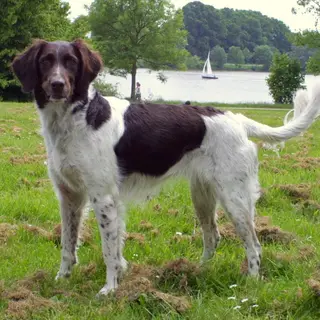
Use the whole outline, coat, proportions, and movement together. A single photo or colour is not enough to establish breed identity.
KLEINER MÜNSTERLÄNDER
FCI nomenclature page > breed namen°7 - Pointing Dogs
FCI nomenclature page > GroupGERMANY
FCI nomenclature page > Country of origin of the breed11/14/2019
FCI nomenclature page > English standard dateBody condition and trend
Height and weight references are already shown above; they are context, not a personal target. Use the BCS tool and the individual dog's ribs, waist, abdominal tuck, age, and trend.
Daily life priorities
Adjust difficulty, duration, and handling for the individual dog. The linked long-tail pages turn these profile facts into practical routines.
Health checks and when to call the vet
If you are choosing a puppy or checking a breeding record, ask for the named test, result, date, and scheme. These checks help assess breeding risk; they are not a diagnosis of an individual dog.
Questions owners ask about Kleiner Mnsterlnder
Verified facts
| Official FCI name | KLEINER MÜNSTERLÄNDER FCI nomenclature page > breed name |
|---|---|
| FCI group | n°7 - Pointing Dogs FCI nomenclature page > Group |
| Country of origin | GERMANY FCI nomenclature page > Country of origin of the breed |
| FCI standard date | 11/14/2019 FCI nomenclature page > English standard date |
| FCI standard PDF | https://www.fci.be/Nomenclature/Standards/102g07-en.pdf FCI nomenclature page > English standard PDF link |
| Utilization | Versatile working gundog FCI standard PDF page text > utilization |
| General appearance | Viewed from the front straight and rather parallel, viewed from the side legs set well under the body. The distance from the ground to the elbows should be approximately equal to the distance from the elbows to the withers. Shoulders: Shoulder blades lying close to the body, strongly muscled. Shoulder and upper arm forming a good angle of approximately… FCI standard PDF page text > general_appearance |
| Coat | Hair: Dense, of medium length, not or only slightly wavy, close lying, water-repellent. The outlines of the body may not be hidden by too long coat. By its density it should provide as good a protection against weather, unfavourable terrain conditions and injuries as possible. Short smooth coat on the ears is faulty. Forelegs feathered, hindlegs with… FCI standard PDF page text > coat |
| Historical summary | The breeding of th is breed in the north German Münsterland has been documented since around 1870. The blood of hundreds of years of old flushing and pointing dogs flowed in the Kleiner Münsterländer. In 1912, the "Association for Kleine Münsterländer Poining Dogs (Heidewachtelhunde)" was founded in the parent country Germany to preserve and promote these… FCI standard PDF page text > historical_summary |
| Important proportions | The length of the body , measured from the prosternum to the point of the buttock, should exceed the height at the withers. The goal is a ratio 1 to 1.1. The length of the skull from the occiput to the stop is equal to the length of the muzzle from the stop to the nose. The distance from the ground to the elbows should be approximately equal to the distance… FCI standard PDF page text > important_proportions |
How to use this profile
Use the facts on this page as a starting point, then observe the individual dog. A breed label does not establish behaviour frequency, diagnosis, or a guaranteed outcome. Medical and screening claims remain subject to review.
Research status
Source register
Use the tools