Breed guide
Portuguese Warren Hound Portuguese Podengo
A source-linked starting point for Portuguese Warren Hound Portuguese Podengo: Hunting dog, watch dog and companion dog. Use this as context for the individual dog's routine, not as a prediction of behaviour or health.
About this breed
How to use this Portuguese Warren Hound Portuguese Podengo profile
For Portuguese Warren Hound Portuguese Podengo, the verified profile records Official FCI name, FCI group, Country of origin. These references explain what to observe and what to adjust in daily life; they do not establish a guaranteed behaviour rate, diagnosis, or outcome for an individual dog.
How to recognize the breed
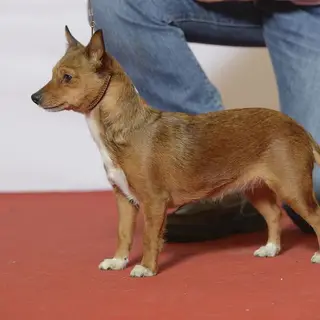
Use the whole outline, coat, proportions, and movement together. A single photo or colour is not enough to establish breed identity.
PODENGO PORTUGUÊS
FCI nomenclature page > breed namen°5 - Spitz and primitive types
FCI nomenclature page > GroupPORTUGAL
FCI nomenclature page > Country of origin of the breed3/30/2009
FCI nomenclature page > English standard dateBody condition and trend
Height and weight references are already shown above; they are context, not a personal target. Use the BCS tool and the individual dog's ribs, waist, abdominal tuck, age, and trend.
Daily life priorities
Adjust difficulty, duration, and handling for the individual dog. The linked long-tail pages turn these profile facts into practical routines.
Health checks and when to call the vet
If you are choosing a puppy or checking a breeding record, ask for the named test, result, date, and scheme. These checks help assess breeding risk; they are not a diagnosis of an individual dog.
Questions owners ask about Portuguese Warren Hound Portuguese Podengo
Verified facts
| Official FCI name | PODENGO PORTUGUÊS FCI nomenclature page > breed name |
|---|---|
| FCI group | n°5 - Spitz and primitive types FCI nomenclature page > Group |
| Country of origin | PORTUGAL FCI nomenclature page > Country of origin of the breed |
| FCI standard date | 3/30/2009 FCI nomenclature page > English standard date |
| FCI standard PDF | https://www.fci.be/Nomenclature/Standards/094g05-en.pdf FCI nomenclature page > English standard PDF link |
| Utilization | Hunting dog, watch dog and companion dog FCI standard PDF page text > utilization |
| Temperament | Large Podengo: used for hunting big game. Medium Podengo: also known as Warren Hound, its natural aptitude as a rabbit hunter is well used, hunting either in a pack or alone. Small Podengo: used for searching rabbits in holes and rocks. All varieties are also used as watch dogs and as companion dogs FCI standard PDF page text > temperament |
| General appearance | Upright when seen from back and sides; well muscled and lean; parallel to the main body line. Thigh: Long; of medium width; well muscled. Stifle joint: Femur-tibia angle approximately 135º. Second thigh: Inclined; long; lean, strong, well muscled. Hock: Of medium height; lean; strong; open hock angle, approimately 135º. Metatarsus (Rear Pastern) : S trong;… FCI standard PDF page text > general_appearance |
| Coat | Silky and/or with undercoat. SEVERE FCI standard PDF page text > coat |
| Weight | Small: 4 to 6 Kg Medium: 16 to 20 Kg Large: 20 to 30 Kg FCI standard PDF page text > weight |
| Historical summary | Primitive ty pe dog, it probably originates from the ancient dogs brought by the Phoenicians and Romans to the Iberian Peninsula in the Classic Antiquity. It was subsequently influenced by the introduction of dogs accompanying the Moors in their invasions in the 8th century. It adapted to the Portuguese terrain and climate, to become what is nowadays known… FCI standard PDF page text > historical_summary |
| Gait | Light trot, easy and agile movement. SKIN: Thin and tight. Mucous membranes pr eferably dark FCI-St. N° 94 / 30.03.2009 6 FCI standard PDF page text > gait |
How to use this profile
Use the facts on this page as a starting point, then observe the individual dog. A breed label does not establish behaviour frequency, diagnosis, or a guaranteed outcome. Medical and screening claims remain subject to review.
Research status
Source register
Use the tools